
The MDL of Remote-Sensing Methods should be defined as a Mass-Flow-Based PoD
Contribution to the design of the implementing act under Art. 14 of the EU Methane Regulation (EU) 2024/1787 for underground installations – Addressee: European Commission, DG Energy (DG ENER)
August 3, 2026
The EU Methane Regulation mandates the detection of leaks for underground gas infrastructure. The two-stage process distinguishes between locating a potential leak and assessing whether it needs repair. For the second step, measurement procedures and repair thresholds are clearly defined, because the techniques used have long been established. For the first step, the Regulation expressly provides for different methods, including the use of airborne remote sensing. The limits for the suitability of these measurement techniques must now be established by the implementing act.
This paper argues that the Minimum Detection Limit (MDL) for remote-sensing methods can properly be defined only as a mass-flow-based probability of detection – the probability of finding a source of defined strength in g/h. The recommendations are:
- The MDL for remote-sensing methods in LDAR Stage 1 is set as a minimum PoD at a defined methane emission mass flow, to be demonstrated under all relevant operating conditions within the declared scope of application.
- Compliance is verified by independent third parties by means of controlled-release tests.
- For local point measurements and the second LDAR stage, the MDL remains a concentration quantity; the procedurally appropriate expression of the term thus differs by measurement method.
- The specific test methodology and the numerical thresholds remain reserved for the CEN standardisation process. The implementing act sets the correct metric, not the detailed values.
1. The MDL for remote sensing is not yet defined
Art. 14 of the Regulation identifies the „minimum detection limit“ as the quantity to be established in the implementing act[1]. The term generally denotes the smallest leak that a method can still detect reliably. How this quantity is to be expressed in concrete terms, however, follows not from the term itself but from the measurement method to which it is applied. For local point measurement methods, the MDL has always been a concentration, because their measurement procedure requires deployment in the immediate vicinity of the source and thereby fixes the measurement geometry. For remote-sensing methods, by contrast, the term is not yet defined in the context of the implementing act.
No reinterpretation of fixed wording is therefore required, but rather the first-time filling-in of an open definition. For remote sensing, the MDL can be determined – physically and operationally – only as a mass-flow-based probability of detection, the probability of finding a source of a given strength in g/h. PoD and MDL are thus not in opposition; the PoD at a defined source strength is the MDL of this class of methods.
This filling-in has already been carried out in standards in force. The DVGW Code of Practice G 465-4-5 for airborne gas remote detection of buried pipelines requires – alongside a sensor-based detection limit in ppm·m – the secure detection of a defined underground leak, defined as at least four hits in five overflights, hence an 80 % probability of detection at a defined mass flow[2]. The US Environmental Protection Agency (EPA) defines the „Minimum Detection Limit“ for remote-sensing and continuous-monitoring methods as the emission rate at 90 % probability of detection[3] (Section 5). The following section justifies this definition from the way airborne measurement works.
2. Why the definition depends on the measurement method
Local point measurement methods can state the MDL as a concentration because their fixed proximity to the source makes the measurement situation unambiguous: once the geometry is fixed by procedure, suitability depends on only a single quantity – how sensitively the device responds at this defined distance. The MDL thus describes precisely the one degree of freedom that remains after the geometry has been fixed.
With airborne remote sensing this precondition falls away. The measurement captures – whether active LiDAR methods or passive measurement techniques are used – always a cross-section through the entire gas plume. In measurement terms, the contribution of all gas molecules along the measurement path is summed; the quantity captured is the integral of the gas concentration along the cloud cross-section, with the unit ppm·m, which is why remote-sensing techniques are assessed by their NECL (Noise Equivalent Column Density). One immediate consequence is that the distance to the source – within certain limits – is precisely not the key to a good measurement: an emission near the ground can be reliably captured even from many hundreds of metres of altitude. The column concentration alone is not a reliable measure of suitability: under the DVGW Code of Practice G 465-4-5, the methane column concentration of an indication must not be used on its own to assess a gas release, because soil, surface and weather strongly influence the detected gas–air mixture[4].
This removes precisely the geometric quantity that gives the ground-based measurement its unambiguity. Whether a leak can be found is now decided not by sensor sensitivity alone, but equally by the spatial resolution, the measurement duration along the flight path, the spatial coverage, and the measurement positioning relative to the horizontally extended gas plume. Current PoD models for remote sensing combine emission rate, wind speed, spatial resolution and concentration noise in a single observability parameter that determines the probability of detection[5]. None of these factors is a property of the sensor alone, and none can be fixed by a simple rule the way proximity can in ground-based measurement. Remote sensing is therefore a measurement method, not a single measuring device.
A detection limit that describes the sensitivity of the sensor alone cannot represent the suitability of such a method. A device with excellent NECL can miss a relevant leak if coverage, resolution or positioning are inadequate; conversely, a method with a nominally weaker sensor can detect robustly if these procedural parameters are well chosen. An MDL understood as a pure sensor quantity therefore leads to gross misjudgements of a technology’s suitability. The only appropriate quantity is one that captures the complete method: the probability with which it finds a leak of a given source strength, i.e. the probability of detection referred to the emission mass flow. Such method-level PoD models remain valid across sites, terrain, wind conditions, aircraft types and flight parameters[6].
3. The PoD curve: an established, reproducible procedure
The detection limit understood in this way is no less testable than a concentration MDL – it is more reproducible, because it tests the complete method under real conditions rather than the sensor in the laboratory. The determination procedure is scientifically established: from controlled releases, hits (detected) and misses (not detected) are recorded, from which a PoD curve over the emission rate is estimated by regression[7]. It yields the emission mass flow at which a given probability of detection – say 90 % – is reached; this value is the MDL of the method. Influencing variables such as wind can be integrated explicitly into the metric, for example as a wind-normalised detection limit[8].
What is decisive for regulation is that this procedure implicitly captures measurement-point density, deployment logic, data processing and the limits of the method. It is technology-neutral – it does not prescribe how a method must work, but only assesses whether it accomplishes the task – and verifiable by independent third parties. The relevant upstream-industry guidance, too, evaluates detection technologies by probability of detection at an emission threshold and bases their validation on blinded controlled-release tests by third parties[9].
4. European compatibility: Emsbüren, DVGW and TADI
For the case relevant here – buried pipelines – this approach is already established in practice in Europe. The test facility in Emsbüren (north-west Germany), operated by OGE GmbH on behalf of DVGW, simulates leaks in a buried pipeline with controlled emissions in line with the test scenario of G 465-4-5[10]. It is open to all interested parties and allows the independent, reproducible determination of the probability of detection at a defined source rate under real conditions – the very test that the implementing act needs for the certification of Stage-1 methods. Emsbüren is thus an obvious European reference site for validating mass-flow-based PoD requirements at underground infrastructure.
The approach extends beyond the immediate DVGW context. The French TADI platform (TotalEnergies Anomalies Detection Initiatives) and the US-based METEC published in April 2025 a joint international protocol for the evaluation of methane detection technologies, supported by the European Commission’s Directorate-General for Energy (DG ENER) and the US Department of Energy – on the grounds that no recognised procedure for validating methane measurement methods yet exists[11]. Independent European controlled-release studies, for instance at a decommissioned underground gas storage compressor station, assess method performance via detection-limit curves and thus via the same PoD logic[12].
Thus not only the relevant European industry standard (G 465-4-5) but also the Directorate-General responsible for the implementing act itself supports a PoD- and mass-flow-based validation procedure. Defining the MDL as a pure concentration quantity would run counter to these established and emerging procedures and would impede the bridge to future CEN standards.
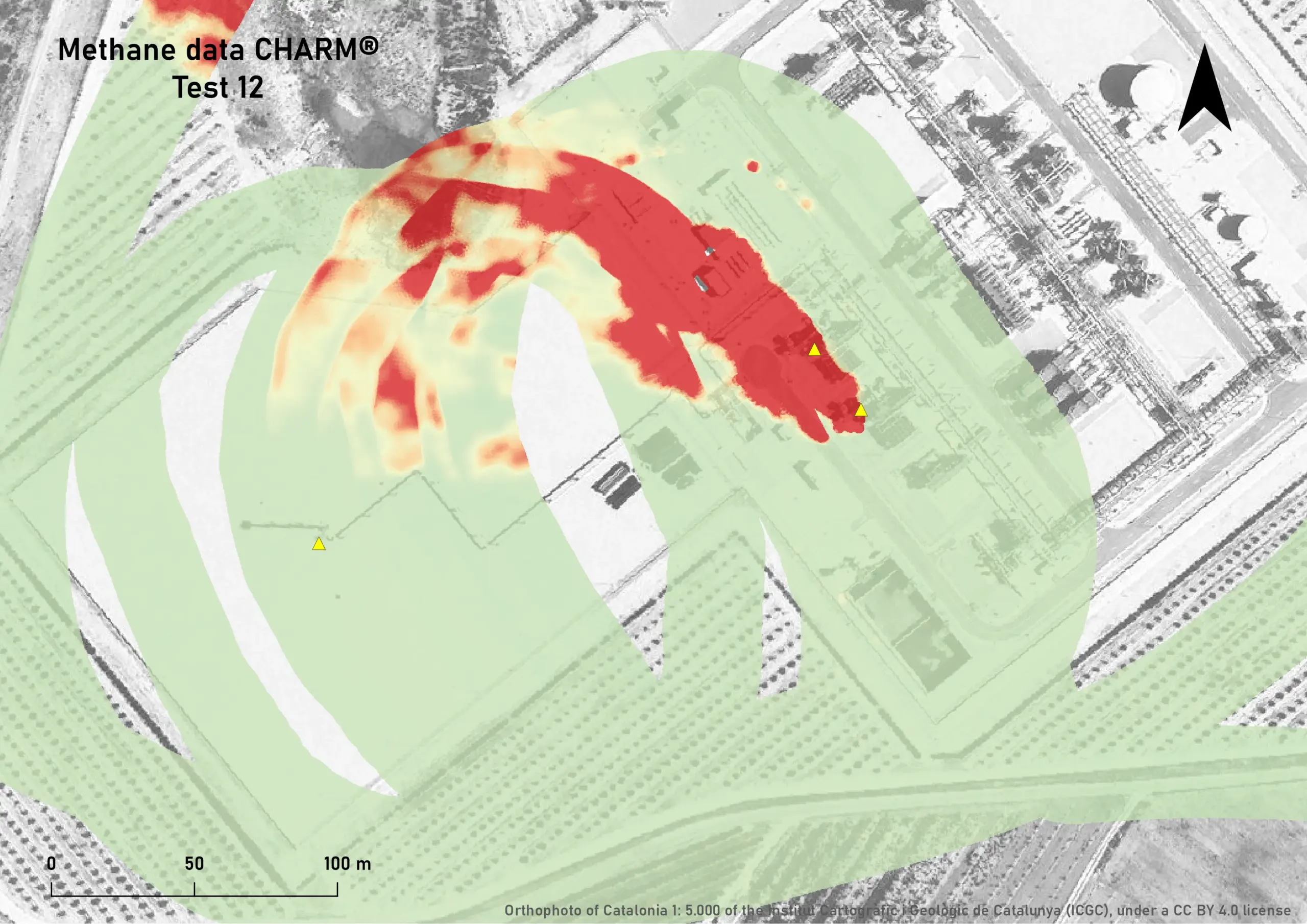
5. Precedent: the MDL is already understood as a PoD at mass flow
Standards in force in Europe and the USA already express the MDL for remote sensing in mass-flow terms. The DVGW Code of Practice G 465-4-5 (successor to G 501:2012) requires the secure detection of an underground leak of at most 150 l/h, demonstrated as at least four hits in five overflights – an 80 % probability of detection at a defined mass flow – in each case at three flight altitudes, three flight speeds and at least 2 m/s wind, combined with operating limits to be demonstrated (flight altitude, flight speed, wind speed) and requirements for spatial route coverage. A required hit rate at a defined mass flow is a PoD; the approach advocated here thus adopts the systematics of the relevant European standard. In the ongoing European debate, too, the MDL is expressed in mass-flow terms: submissions that criticise low thresholds quantify the „lowest third-party validated MDL“ in g/h, not in ppm[13].
The most formalised confirmation comes from US regulation. Under 40 CFR Part 60 the EPA permits „Alternative Test Methods“ whose performance is consistently defined in the format „X % PoD at Y kg/h“[14]. The „Minimum Detection Limit“ is defined therein as the emission rate at 90 % PoD and cleanly separated from the instrumental sensor sensitivity – for example a sensor MDL of 0.06 kg/h alongside a method-level sensitivity of 1–15 kg/h[15]. The European industry standard and US regulation therefore understand the MDL of a remote-sensing method as a mass-flow-based PoD, not as a concentration value.
6. Proposal for the requirements in the implementing act
The implementing act should fill in the MDL in a method-dependent way and assess remote-sensing methods for the first LDAR stage against the following criteria. The numerical thresholds and the detailed design of the test remain reserved for the CEN standardisation process.
Core metric and distinction from the ground-based MDL. For remote sensing, the MDL is expressed as a minimum PoD at a defined methane emission mass flow; for local point measurements and the second LDAR stage it remains a concentration quantity. Proposed wording:
For remote-sensing methods used as the first step of LDAR surveys for underground components, the minimum detection limit shall be expressed as a probability of detection at defined methane emission rate thresholds. The method shall demonstrate a probability of detection of at least the applicable percentage for methane emissions at or above the applicable emission rate threshold under all relevant operating and environmental conditions within the method’s declared scope of application. For local point measurements performed at or near the suspected leak location, the minimum detection limit may continue to be expressed as a concentration.
Reference point and differentiation. The emission rate should be defined as methane emission from the ground or from the underground installation; the precise design of the test release remains reserved for CEN standards. The emission rate should be defined as methane emission from the underground installation; the precise design of the test release remains reserved for CEN standards. Analogues to the existing framework for above-ground installations , different thresholds for Type-1 and Type-2 inspection should be set, while the detection thresholds for both types remain to be defined by the Implementing Act.
Relevant operating conditions. The PoD must hold within the declared scope of application. This includes in particular permissible distances to the pipeline, permissible driving or flight speeds, meteorological operating limits. A provider may restrict the scope of application but must then demonstrate the PoD within that scope.
Independent verification. Compliance should be verified by independent third parties on the basis of controlled-release tests, blind or single-blind trials, or equivalent field validations. Proposed wording:
Compliance with the required probability of detection shall be verified by an independent third party using controlled release testing, blind or single-blind field trials, or equivalent validation procedures representative of the intended operational use.
Timeliness. The choice of metric is a setting of the course. Were the MDL now fixed as a pure concentration or sensor quantity, providers, authorities and operators would align their technologies, test processes and tenders accordingly, and CEN would later have to standardise against an already established logic. Setting the procedurally appropriate definition now and leaving the detailed methodology to CEN avoids this legal uncertainty – especially as the Regulation does not mandate a concentration-based MDL systematics for the first stage.
Footnotes
[1] Regulation (EU) 2024/1787, Art. 14. The implementing act provided for there is to establish „minimum detection limits, techniques and thresholds“ on the basis of the best available technologies.
[2] DVGW Code of Practice G 465-4-5 (M), „Technical Equipment for the Leakage Survey of Gas Pipework and Gas Stations – Part 5: Airborne Gas Remote Detection“, November 2025 (successor to G 501:2012). The document requires two things: a detection limit of ≤2 ppm·m per VDI 4210 Part 1 (sensor sensitivity, Annex A) and, in addition, the secure detection of an underground leak of at most 150 l/h under flight conditions. „Secure“ is defined as at least four successful methane indications in five overflights (Annex B) – i.e. an 80 % probability of detection at a defined mass flow.
[3] US EPA, Methane Alternative Test Method MATM-009 (SCS/Sensirion Nubo Sphere) defines the „Minimum Detection Limit“ explicitly as the emission rate at 90 % probability of detection – that is, already as a mass-flow-based PoD quantity.
[4] DVGW Code of Practice G 465-4-5 (M), November 2025, Section 4.3.3: the methane column concentration of an indication must not be used on its own to assess a gas release, since local soil and surface conditions and the weather at the time of the survey can strongly affect the gas–air mixture being detected.
[5] E. Manninen, A. Chulakadabba, J. Chen, S. Wofsy et al., „Probabilities of Detection of Methane Plumes by Remote Sensing and Implications for Inferred Emissions Distributions“, EGUsphere Preprint 2026-115, 2026. PoD is modelled via a dimensionless observability parameter combining emission rate, wind speed, pixel area (spatial resolution) and concentration noise.
[6] M. J. Thorpe, A. Kreitinger, B. M. Conrad, M. R. Johnson, D. J. Zimmerle et al., „Deployment-invariant probability of detection characterization for aerial LiDAR methane detection“, Remote Sensing of Environment 315 (2024) 114435. The paper notes that detection sensitivity was previously characterised via the MDL, whereas the emission rate corresponding to, e.g., 90 % PoD can exceed a cited MDL by more than an order of magnitude; the PoD model remains valid across sites, terrain, wind, aircraft types and flight parameters (mean 90 % PoD emission rate 1.27 kg/h, 2023, 12 basins).
[7] PoD is estimated as a function of emission rate via a generalised linear model (logistic regression) from the hits (true positives) and misses (false negatives) of controlled releases – an established statistical standard method.
[8] M. Bell, T. Vaughn, D. Zimmerle et al., „Single-blind determination of methane detection limits and quantification accuracy using aircraft-based LiDAR“, Elementa 10(1), 2022. Wind-normalised detection limit (90 % PoD) of 0.25–0.41 (kg/h)/(m/s) depending on flight altitude.
[9] IOGP/OGCI/Ipieca/Energy Institute, „Recommended practices for methane emissions detection and quantification technologies – upstream“, Report 661, Rev. 2.0, March 2025. The industry’s own guidance evaluates technologies by probability of detection at an emission threshold (Section 4.5.2) and bases validation on fully or partially blinded controlled-release tests by third parties.
[10] The Emsbüren test facility (north-west Germany, operated by OGE GmbH on behalf of DVGW, open to all interested parties) simulates leaks in an underground pipeline with controlled emissions in line with the test scenario of G 465-4-5, Annex B – buried pipes with 800 mm cover, sealed and unsealed surfaces, demonstration at three flight altitudes and three flight speeds and wind speeds of at least 2 m/s.
[11] TotalEnergies, „TADI and METEC publish an international protocol for the evaluation of methane detection and quantification technologies“, April 2025. The initiative is supported by the US Department of Energy and the European Commission’s Directorate-General for Energy (DG ENER), on the grounds that no recognised procedure for validating methane measurement methods yet exists.
[12] Cf., for example, the European blind controlled-release study at a decommissioned underground gas storage compressor station, focused on technologies available in Europe: Atmospheric Measurement Techniques 17, 1633–…, 2024.
[13] In the European debate, too, the MDL for airborne detection is already expressed in mass-flow terms: in its response to the EC questionnaire (16 May 2025), IOGP Europe refers to the „lowest third-party validated MDL“ of about 1,000 g/h – i.e. to an emission rate, not a concentration.
[14] US EPA, 40 CFR Part 60, Subparts OOOO/OOOOa/OOOOb and Emissions Guidelines OOOOc; Advanced Methane Detection programme with Alternative Test Methods (ATM). Performance is consistently defined as „X % PoD at Y kg/h“, e.g. ≤1, 2, 3, 5, 10 or 15 kg/h at 90 % PoD (MATM-002, Bridger Photonics).
[15] MATM-009 defines the MDL as the emission rate at 90 % PoD; MATM-005 (LongPath) distinguishes between the instrumental sensor MDL of 0.06 kg/h and the method-level sensitivity of 1–15 kg/h.